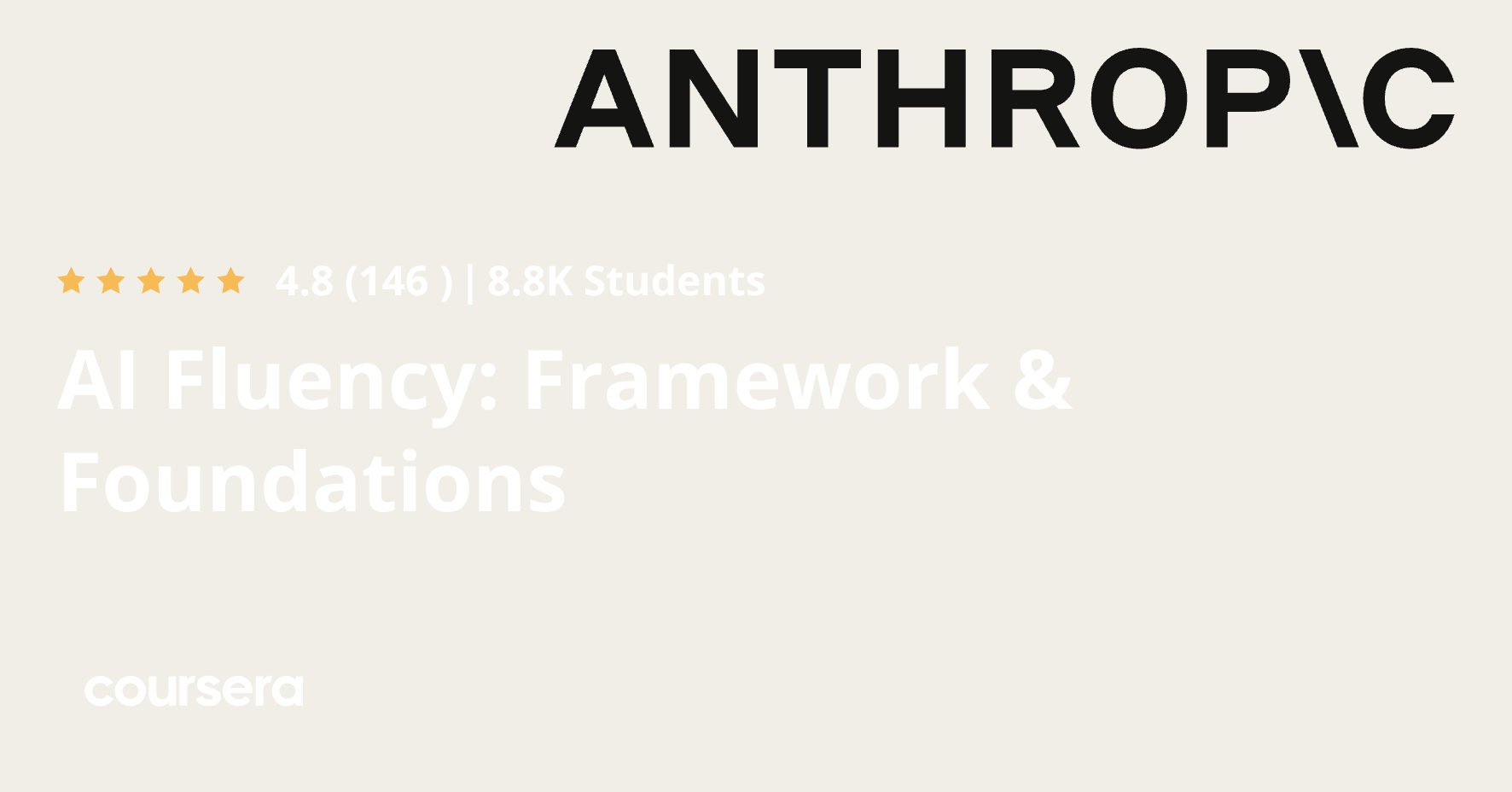
Is Coursera’s AI Fluency: Framework & Foundations Worth It If There’s No Certificate?

If you’re looking to build practical AI skills but don’t want to pay for a certificate, you might wonder if a free course without any official document is worth your time. Coursera’s “AI Fluency: Framework & Foundations” offers all materials at no cost, but makes it clear: there’s no certificate, badge, or proof of completion.
So, does this course deliver enough value for someone who just wants to understand how to work with AI, especially if you’re aiming to use these skills in real business or creative projects? This article breaks down who will benefit, what you’ll actually learn, and the real limitations—so you can decide if it’s the right fit for your goals.
Who Should—and Should Not—Take This Course? The Bottom Line

Best for:
- Beginners in any field who want a structured, practical way to collaborate with AI.
- Managers, business owners, and creative professionals who need to understand AI’s role in real-world projects, not just theory.
- Anyone seeking a durable framework for working with AI tools, rather than chasing the latest trend.
Not for:
- Those who need a certificate for their CV, job application, or professional development requirements.
- Learners looking for advanced technical content, coding, or in-depth AI model training.
- People who want a quick “tips and tricks” guide for a specific AI tool.
Bottom line:
If you want a free, research-backed course to build real AI collaboration skills—and you don’t care about getting a certificate—this is one of the most practical options available.
What You’ll Actually Learn: Inside the 10 Modules
This course is built around the 4D Framework: Delegation, Description, Discernment, and Diligence. Each module is focused on developing a specific skill for human-AI collaboration, with practical readings and one assignment. Here’s what’s covered:
1. Course Foundations: Why the course focuses on collaboration with AI, not just technical details.
2. The AI Fluency Framework: Understanding the four core competencies and how they apply to Automation, Augmentation, and Agency.
3. Generative AI Fundamentals: What makes generative AI different, including concepts like context windows, emergent capabilities, and common limitations.
4. Delegation: How to decide what tasks to give to AI and how to plan projects that use AI effectively.
5. Description: Turning your intent into clear, structured prompts—moving beyond “just ask” to a repeatable process.
6. Prompt Engineering: Six key techniques for writing effective prompts, including context, examples, and constraints.
7. Discernment: Evaluating AI outputs critically, spotting errors, and knowing when to intervene.
8. Iterative Collaboration: Applying a feedback loop to refine prompts and improve results over multiple steps.
9. Diligence: Ethical use of AI—understanding creation, transparency, and deployment responsibilities.
10. Putting It All Together: Reviewing all four competencies, plus extra activities for ongoing skill development.
How the 4D Framework Changes Your Approach to AI
Many people treat AI as a black box: you type a prompt, hope for the best, and accept whatever comes out. The 4D Framework taught in this course breaks that cycle by giving you a clear structure for every interaction with AI.
- Delegation is about knowing which tasks should be handed off to AI and which need your own judgement. For example, imagine a marketing manager in Lagos planning a new campaign. Using Delegation, she decides to let AI generate initial content ideas but keeps the final brand messaging decisions for herself.
- Description means you don’t just tell the AI “write an ad”—you specify the audience, the tone, and the outcome you want. This makes the AI’s output far more useful.
- Discernment is your filter: you learn to spot when the AI’s answer is off, incomplete, or risky, instead of accepting it blindly.
- Diligence ensures your use of AI is ethical and responsible—vital for anyone working with sensitive data or public communications.
By mastering these four skills, you become an active collaborator with AI, not just a passive user.
Strengths and Weaknesses: Where This Course Stands Out (and Where It Doesn’t)
Strengths
- Fully free: All readings, activities, and the assignment are available at no cost—no card required.
- Practical, not just theory: Focuses on real-world collaboration, not just explaining how AI works.
- Framework is durable: The 4D approach applies across tools and industries, so you’re not left behind as technology changes.
- Short and focused: Three hours is enough to get a solid foundation without feeling overwhelmed.
Weaknesses
- No certificate: You won’t get any document, badge, or proof of completion.
- No video content listed: The course relies on readings, which may not suit all learning styles.
- Not for advanced users: If you already work with AI models or want technical depth, this will feel too basic.
When This Course Isn’t the Right Fit—and What to Do Instead
If you need a certificate to prove your skills, this course will not meet your needs. Coursera does offer other AI courses with optional paid certificates, but you’ll need to check the details on each course page—some are free to study, others require payment even for access.
For those wanting more technical skills (like building or fine-tuning AI models), look for free introductory programming or data science courses instead. If you’re in education, “AI Fluency for Educators” (also free) may be a better fit for classroom-focused skills.
Key Details: Access, Cost, and How to Start
- Free to study: All course materials are open access—no payment or card required.
- No certificate: There is no option to get a certificate, even for a fee.
- Flexible schedule: Study at your own pace; suggested deadlines can be reset.
- Mobile access: The Coursera app allows you to read materials and complete assignments from your phone or tablet.
- How to start: Go to the official course page and choose the free enrolment option—do not enter card details if you only want the free version.
Go to the official course page
Wrapping Up: Who Gets the Most Value and What Comes Next
This course is ideal if you want to build a reliable foundation for working with AI, especially in business, creative, or educational projects, and you do not need a certificate. After finishing, the next step is to practise the 4D Framework in your own work—try structuring your next AI project using Delegation, Description, Discernment, and Diligence, or explore other free Coursera courses that offer certificates if you need formal proof of skills.
FAQ
Can I get a certificate after finishing this course?
No, this course does not offer any certificate, badge, or proof of completion.
Is there any cost or hidden fee for accessing the full course?
No, all features and content are available for free—no payment or card required.
Is this course suitable for someone with no technical background?
Yes, it is designed for complete beginners and focuses on practical collaboration with AI, not coding or technical details.
OFFICIAL SOURCES
- Coursera, AI Fluency: Framework & Foundations course page: https://www.coursera.org/learn/ai-fluency-framework-foundations
This website is an independent guide. We are not affiliated with, or endorsed by, Coursera, nor by any certification body mentioned in this article. Course content, prices, entry requirements and application dates are set by the provider and can change at any time. Always confirm the current details on the official course page before enrolling.